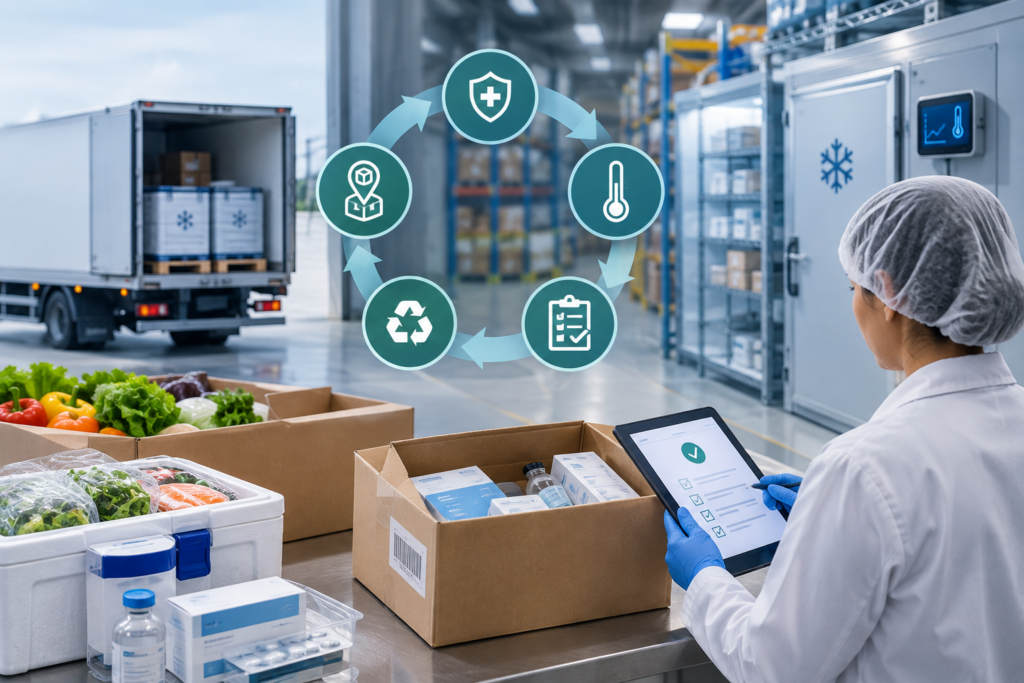
In industries where product safety directly affects human health, managing returns is far more complicated than simply moving products from a customer back to a warehouse. Reverse logistics for medical and food products requires strict controls over product condition, temperature, traceability, documentation, storage, and final disposition.
For pharmaceutical companies, healthcare suppliers, food manufacturers, distributors, and retailers, an improperly managed return can create health risks, regulatory violations, financial losses, and reputational damage. A strong reverse logistics strategy therefore needs to balance operational efficiency with regulatory compliance and product safety.
What Is Reverse Logistics?
Reverse logistics is the process of moving products backward through the supply chain, typically from the customer or point of sale back to a distributor, warehouse, manufacturer, or authorized disposal facility.
Traditional logistics focuses on getting products to customers. Reverse logistics focuses on what happens afterward.
Returns may occur because of:
- Damaged packaging
- Incorrect shipments
- Product recalls
- Expired products
- Temperature excursions
- Customer cancellations
- Excess inventory
- Quality concerns
- Regulatory requirements
In conventional industries, returned products may sometimes be inspected and placed back into inventory. For medical and food products, however, that decision requires much greater scrutiny.
Why Reverse Logistics Is Critical for Medical and Food Products
Medical and food supply chains have one major characteristic in common: product integrity cannot be compromised.
A medical product returned by a hospital may have been stored under unknown conditions. A refrigerated food product may have experienced a temperature excursion during transportation. Even when an item appears physically undamaged, its safety or effectiveness may no longer be guaranteed.
This means companies need clear procedures for determining whether a returned product can be:
- Returned to inventory
- Reworked or repackaged
- Quarantined for further inspection
- Returned to the manufacturer
- Recalled
- Destroyed or safely disposed of
The objective is not simply to recover product value. It is to protect consumers and patients while maintaining a documented and auditable supply chain.
The Role of Compliance in Reverse Logistics
Compliance should be built into every stage of the returns process rather than treated as a final checkpoint.
For medical products, organizations may need to consider requirements relating to Good Distribution Practices (GDP), product traceability, storage conditions, recalls, and controlled handling. Depending on the product and market, companies may also need to comply with requirements from regulatory authorities such as the U.S. FDA or relevant national authorities.
Food companies face their own requirements, including food safety systems, hygiene controls, temperature management, traceability, and hazard prevention. Standards and frameworks such as HACCP and ISO 22000 can play an important role in establishing structured food safety processes.
The exact requirements vary according to the product, country, and supply-chain role. However, the principle remains the same: companies must be able to demonstrate how returned products were handled and why a particular disposition decision was made.
Managing Temperature-Sensitive Returns
Temperature control is one of the biggest challenges in reverse logistics for medical and food products.
Products such as vaccines, certain medicines, fresh foods, dairy products, meat, and other temperature-sensitive goods may require controlled conditions throughout transportation and storage.
A return therefore cannot simply be placed on a standard warehouse receiving dock.
Companies should establish procedures for:
- Recording product temperature upon receipt
- Reviewing temperature-monitoring data
- Maintaining cold-chain conditions during transportation
- Separating potentially compromised products
- Documenting temperature excursions
- Determining whether the product remains usable
For example, if a refrigerated food shipment is returned after several hours outside the required temperature range, visual inspection alone may not be sufficient to determine its safety.
Similarly, a medical product exposed to unsuitable temperatures may require a formal quality assessment before it can be released.
Traceability: Knowing Where Every Return Came From
Traceability is another essential component of compliant reverse logistics.
Companies should be able to answer basic questions about every returned product:
Where did it come from? Who handled it? When was it returned? Under what conditions was it transported? What happened to it afterward?
Effective traceability may involve product codes, batch or lot numbers, serial numbers, expiration dates, customer information, shipment records, and inspection results.
Digital warehouse management systems and barcode or RFID technologies can make this process significantly more efficient.
Instead of relying on spreadsheets or manual paperwork, companies can create a digital record that follows a product throughout its reverse journey.
This becomes particularly important during product recalls. A reliable traceability system can help organizations identify affected batches quickly, isolate inventory, and document the recall process.
Quarantine and Inspection: Never Assume a Return Is Safe
One of the most important principles of medical and food reverse logistics is separation.
Returned products should not automatically be mixed with saleable inventory.
A dedicated quarantine area allows warehouse teams to separate returned, damaged, expired, or potentially contaminated products while quality personnel determine the appropriate next step.
The inspection process may evaluate:
- Packaging condition
- Product integrity
- Expiration date
- Batch or lot information
- Temperature history
- Signs of contamination
- Evidence of tampering
- Reason for return
- Storage and transportation conditions
Only products that meet the organization’s documented release criteria should be considered for reintegration into inventory.
Choosing the Right Disposition
Not every returned product should be discarded.
A well-designed reverse logistics system categorizes products based on risk and condition.
Some products may be eligible for resale or return to inventory after inspection. Others may require repackaging, refurbishment, manufacturer evaluation, or controlled destruction.
For food products, safety concerns may mean that certain returns cannot be resold even when their packaging appears intact.
For medical products, product integrity and regulatory requirements can similarly restrict opportunities for resale.
The decision should therefore be based on documented procedures rather than simply the potential financial value of the returned item.
Technology Can Make Reverse Logistics More Efficient
Technology is increasingly important in managing compliant returns.
Warehouse Management Systems (WMS), Enterprise Resource Planning (ERP) platforms, barcode scanning, IoT temperature sensors, and digital documentation can improve visibility across the reverse supply chain.
Automated alerts can notify teams when temperature limits are exceeded. Barcode scanning can connect returned products to their original shipment and batch information. Digital records can create an audit trail showing who inspected a product and what decision was made.
For companies managing large volumes of returns, these technologies can reduce manual errors while improving both operational efficiency and compliance.
Building a Strong Reverse Logistics Strategy
Companies looking to improve their reverse logistics processes should focus on five priorities.
First, establish clear return procedures. Employees and logistics partners should know what can be returned, where it should go, and how it must be handled.
Second, create dedicated quarantine processes. Returned products should be physically and digitally separated until their status is determined.
Third, strengthen traceability. Every return should have sufficient information to establish its origin, condition, and final disposition.
Fourth, train employees and logistics partners. Even sophisticated technology cannot compensate for poorly trained personnel.
Finally, continuously review performance. Companies should monitor return volumes, causes, processing times, disposal rates, temperature excursions, and compliance issues to identify opportunities for improvement.
Conclusion
Reverse logistics for medical and food products is not simply a transportation challenge. It is a critical component of supply-chain safety, regulatory compliance, and risk management.
When returns are handled without proper controls, companies can expose customers and patients to unsafe products while creating serious regulatory and financial risks. When reverse logistics is designed around traceability, temperature control, quarantine, inspection, documentation, and appropriate product disposition, returns become a controlled and measurable part of the supply chain.
The most effective strategy is therefore to treat every return as a product-safety decision—not just another warehouse transaction.
By combining clear procedures, trained personnel, reliable technology, and strong compliance controls, medical and food companies can manage returns efficiently while protecting consumers, reducing waste, and maintaining trust throughout the supply chain.