Introduction
Medical devices are essential to modern healthcare, supporting diagnosis, treatment, patient monitoring, and medical procedures. From surgical instruments and diagnostic equipment to disposable medical supplies, these products require appropriate storage and handling to maintain their quality, safety, and functionality.
In Saudi Arabia, the continued development of healthcare infrastructure has increased the importance of reliable medical device logistics. Hospitals, clinics, distributors, and healthcare suppliers depend on organized warehousing operations to maintain product availability and support uninterrupted healthcare services.
Unlike conventional consumer goods, medical devices may require specialized environmental controls, careful handling, batch or serial number tracking, and compliance with applicable regulatory requirements.
Understanding the best practices for medical device warehousing helps businesses reduce operational risks, protect valuable inventory, and improve supply chain efficiency.
1. Understanding Medical Device Warehousing
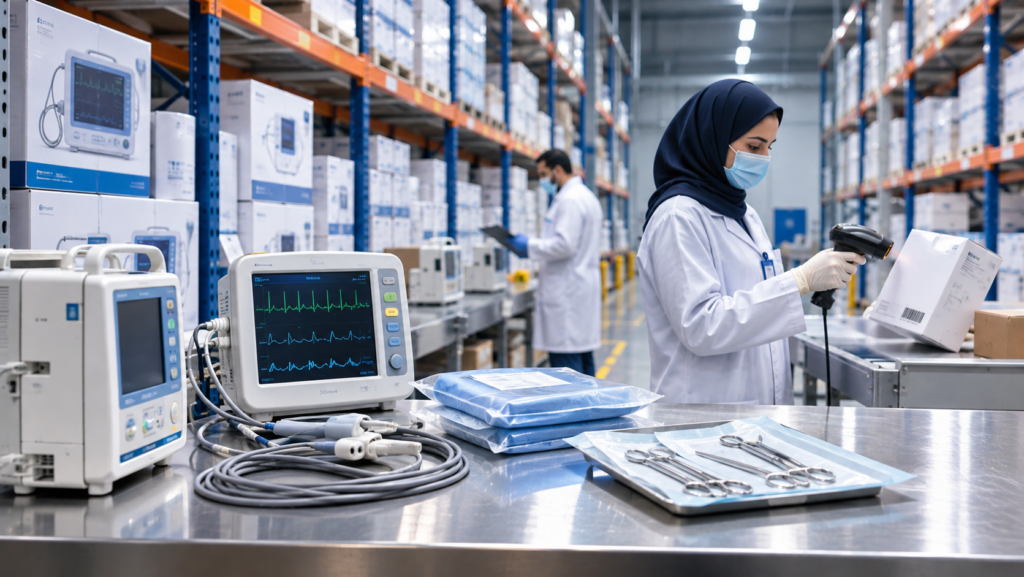
Medical device warehousing involves receiving, inspecting, storing, managing, and preparing medical devices and related supplies for distribution.
The requirements vary according to the product’s characteristics, intended use, packaging, and manufacturer instructions.
For example, large diagnostic equipment may require secure storage and specialized handling, while sterile surgical supplies must be protected from conditions that could compromise their packaging integrity.
Some medical devices are sensitive to temperature, humidity, vibration, or physical impact.
An effective warehouse operation must account for these differences rather than applying identical storage procedures to every product.
Proper classification and documented handling instructions are therefore essential components of medical device inventory management.
2. Maintaining Appropriate Storage Conditions
Suitable environmental conditions help protect medical devices from deterioration, damage, and performance issues.
Storage requirements should follow the manufacturer’s instructions and applicable regulatory requirements.
Depending on the product, warehouse operators may need to monitor temperature, humidity, cleanliness, or exposure to direct sunlight.
For example, electronic diagnostic devices may be sensitive to excessive heat or moisture, while sterile medical products require storage conditions that preserve the integrity of their protective packaging.
Important storage practices include:
- Maintaining required environmental conditions.
- Using suitable shelving and storage equipment.
- Protecting products from moisture and contamination.
- Keeping devices away from direct sunlight when required.
- Monitoring storage areas for environmental deviations.
- Maintaining accurate environmental records.
These measures support product quality and help reduce the likelihood of preventable inventory losses.
3. Proper Receiving and Inspection Procedures
The receiving process is the first opportunity to identify potential problems before products enter warehouse inventory.
When medical devices arrive, warehouse personnel should verify shipment documentation and inspect the products according to established procedures.
This may include checking product descriptions, quantities, packaging conditions, batch or serial numbers, and expiration dates where applicable.
Any damaged, incorrect, or potentially compromised products should be identified and handled according to documented quality procedures.
Receiving teams should also confirm whether temperature-sensitive products were transported under appropriate conditions when relevant.
Accurate receiving records improve inventory visibility and help prevent unsuitable products from entering active distribution channels.
4. Safe Handling of Medical Devices
Medical devices can be damaged through improper lifting, stacking, transportation, or warehouse handling.
Some products contain delicate electronic components, precision instruments, or fragile materials that require additional protection.
Warehouse teams should follow manufacturer handling instructions and use suitable equipment when moving products.
Practical measures include:
- Using appropriate lifting and material-handling equipment.
- Avoiding excessive stacking or compression.
- Protecting fragile devices from vibration and impact.
- Keeping products in suitable protective packaging.
- Training employees on product-specific handling requirements.
- Clearly identifying products requiring special care.
Safe handling procedures help preserve device functionality and reduce damage-related returns and replacement costs.
5. Inventory Management and Product Traceability
Accurate inventory management is essential for medical device distribution.
Warehouses must be able to identify product locations, quantities, and relevant tracking information.
Depending on the product and applicable requirements, this may include lot numbers, serial numbers, expiration dates, and Unique Device Identification (UDI) information.
Warehouse Management Systems (WMS) can support these activities by recording inventory movements and improving stock visibility.
For devices with expiration dates, the First Expired, First Out (FEFO) method can help prioritize products approaching expiration.
Products without expiration dates may be managed using other appropriate stock rotation methods.
Strong traceability supports accurate order fulfillment, product investigations, and efficient recall management.
6. Protecting Sterile Medical Supplies
Sterile medical supplies require particular attention because damaged packaging can compromise the sterile barrier.
Examples include sterile surgical instruments, dressings, and certain disposable medical products.
These items should be stored and handled according to manufacturer instructions, with precautions to prevent moisture exposure, crushing, punctures, or contamination.
Warehouse personnel should inspect packaging integrity during receiving, storage checks, and order preparation.
Products with compromised sterile packaging should be segregated and assessed through established quality procedures.
Protecting the sterile barrier helps maintain product suitability and supports safe use in healthcare environments.
7. Order Picking, Packing, and Distribution
Efficient order fulfillment is important for healthcare facilities that depend on timely access to medical devices and supplies.
Warehouse operators should use organized picking procedures to ensure that the correct products and quantities are selected.
Barcode scanning and digital order verification can help reduce errors.
Packing procedures should consider product size, fragility, environmental sensitivity, and transportation requirements.
Large equipment may require specialized packaging or secure loading arrangements, while smaller sterile supplies may need protection against crushing or moisture.
Before dispatch, shipments should be checked against order documentation.
Coordinating warehousing and transportation activities helps improve delivery reliability and reduce avoidable disruptions.
8. Regulatory Considerations in Saudi Arabia
Medical devices in Saudi Arabia are regulated by the Saudi Food and Drug Authority (SFDA).
Businesses involved in medical device storage and distribution must comply with applicable regulatory requirements and relevant manufacturer instructions.
These may include requirements concerning establishment licensing, storage conditions, product traceability, quality management, and the handling of nonconforming or recalled products.
Warehouse operators should maintain appropriate records and ensure that employees understand their responsibilities.
Regulatory requirements can differ depending on the device category and the activities performed by the establishment.
For this reason, companies should regularly review current SFDA requirements and incorporate them into their documented operating procedures.
9. Preventing Common Medical Device Warehousing Problems
Several operational challenges can affect medical device warehousing.
These include incorrect product identification, damaged packaging, inaccurate inventory records, unsuitable storage conditions, and delays in order processing.
Businesses can reduce these risks by establishing clear standard operating procedures and conducting regular warehouse inspections.
Employee training is particularly important when handling specialized or high-value equipment.
Routine inventory checks, equipment maintenance, and performance monitoring can also support continuous improvement.
Useful performance indicators include inventory accuracy, order fulfillment accuracy, product damage rates, and delivery performance.
By identifying recurring problems and addressing their causes, businesses can strengthen operational efficiency and product protection.
10. Choosing the Right Medical Device Logistics Partner
Selecting a suitable logistics partner is an important decision for medical device manufacturers, importers, and distributors.
Businesses should evaluate storage suitability, product handling capabilities, inventory tracking, documentation practices, and transportation coordination.
Experience with healthcare products and familiarity with Saudi regulatory requirements are also valuable considerations.
At Rabiyah Logistics, the importance of organized warehousing and coordinated healthcare distribution reflects the need for dependable supply chain operations.
For medical device businesses, working with a logistics partner that prioritizes product integrity, accurate inventory management, and reliable distribution can help support operational continuity and customer satisfaction.
Conclusion
Medical device warehousing requires more than providing storage space. It involves maintaining suitable environmental conditions, protecting products during handling, ensuring traceability, and coordinating accurate distribution.
For businesses operating in Saudi Arabia, adopting effective warehousing practices helps reduce product damage, improve inventory control, and support compliance with applicable requirements.
By combining trained personnel, documented procedures, suitable infrastructure, and appropriate technology, companies can build safer and more efficient medical device supply chains.