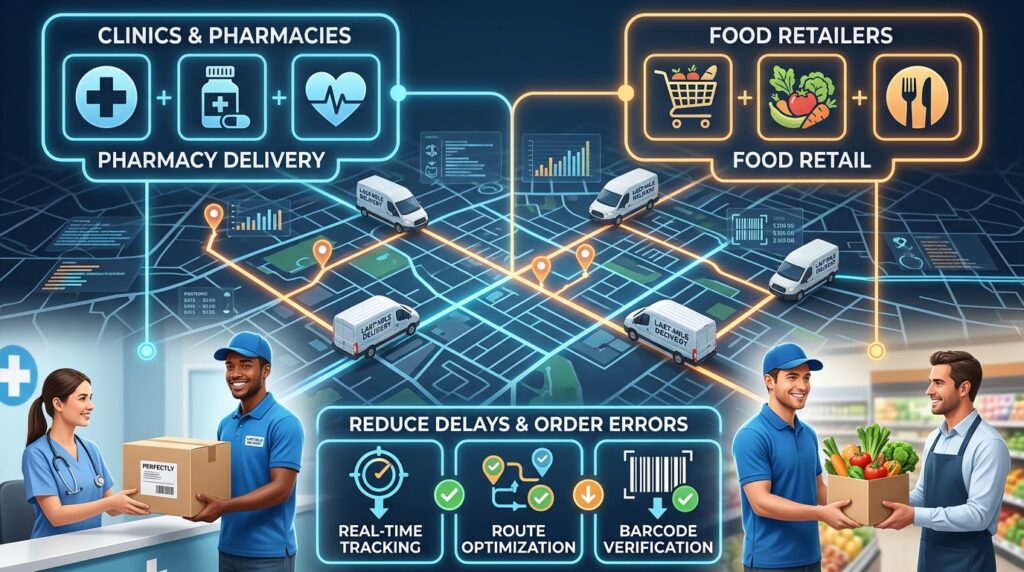
Last-mile delivery is one of the most critical stages of modern supply chain management. Whether a shipment is going to a clinic, pharmacy, supermarket, restaurant, or food retailer, the final stage of delivery can determine whether the entire logistics process succeeds or fails.
For businesses handling pharmaceuticals, medical supplies, food products, and other time-sensitive goods, last-mile delivery presents unique challenges. Traffic congestion, incorrect addresses, poor route planning, picking mistakes, delayed dispatch, and communication gaps can all result in late or incorrect orders.
In Saudi Arabia, where businesses increasingly operate across large and rapidly growing cities such as Riyadh, Jeddah, and Dammam, improving last-mile logistics has become essential. Companies need delivery processes that are accurate, responsive, and capable of handling increasingly demanding customer expectations.
What Is Last-Mile Delivery?
Last-mile delivery refers to the final stage of the supply chain, when products move from a distribution center, warehouse, or local fulfillment facility to the customer or business receiving the order.
Although it is called the “last mile,” the distance is not necessarily one mile. The term describes the final connection between the logistics network and the end customer.
For clinics and pharmacies, last-mile delivery may involve transporting medicines, medical devices, or healthcare supplies. For food retailers, it may involve delivering packaged food, beverages, fresh products, or other inventory to stores and customers.
Because the last-mile stage involves direct delivery, it is often where logistical problems become most visible.
Why Last-Mile Delivery Problems Occur
Delivery delays and order errors rarely have a single cause. They can result from problems at several points in the fulfillment process.
Common causes include:
- Incorrect customer or delivery information
- Picking and packing errors
- Poor route planning
- Traffic and unexpected road delays
- Inaccurate inventory information
- Delayed warehouse dispatch
- Lack of real-time shipment visibility
- Poor communication between drivers and customers
- Manual order processing
- Inadequate proof-of-delivery processes
For businesses managing hundreds or thousands of orders, even a small error rate can create significant operational costs.
This is why improving last-mile delivery management requires more than simply adding more delivery vehicles.
1. Improve Order Accuracy Before Dispatch
One of the most effective ways to reduce delivery errors is to prevent them before the order leaves the warehouse.
An incorrect delivery is often caused by an upstream picking or packing mistake rather than the driver.
Businesses should establish clear processes for:
- Order verification
- Product picking
- Quantity checking
- Barcode scanning
- Packing
- Label verification
- Customer address confirmation
Technology can make these processes more reliable. Barcode and QR-code scanning, for example, can help warehouse employees confirm that the correct product and quantity have been selected.
For pharmacies and clinics, this becomes particularly important because an incorrect product can have consequences beyond the cost of a return or replacement.
2. Use Real-Time Inventory Visibility
Accurate inventory information is essential for efficient last-mile delivery.
Imagine a pharmacy orders ten units of a particular product, but the warehouse system incorrectly shows that all ten are available. The order is accepted, but during picking, the warehouse discovers that only six units are actually in stock.
The result could be a delayed shipment, partial fulfillment, or an unexpected replacement.
A connected inventory management system helps businesses maintain better visibility of available stock. When inventory information is updated in real time, orders can be allocated more accurately and fulfillment teams can identify potential shortages earlier.
This is especially valuable for businesses with multiple branches.
3. Optimize Delivery Routes
Route planning has a major impact on last-mile delivery efficiency.
Sending drivers on inefficient routes can increase travel time, fuel consumption, vehicle operating costs, and the likelihood of late deliveries.
Modern route optimization systems can consider factors such as:
- Delivery locations
- Traffic conditions
- Vehicle capacity
- Delivery time windows
- Driver availability
- Order priority
- Number of stops
- Distance between locations
Instead of planning each route manually, businesses can use digital tools to create more efficient delivery schedules.
For large Saudi cities, route optimization can be particularly useful because delivery teams may need to navigate significant distances and changing traffic conditions.
4. Create Delivery Priorities
Not every order has the same level of urgency.
A pharmacy may require an urgent medical product, while a food retailer may need replenishment before a particular sales period.
Businesses can improve delivery performance by categorizing orders according to priority.
For example:
Priority 1: Urgent healthcare or temperature-sensitive products
Priority 2: Scheduled pharmacy or clinic replenishment
Priority 3: Standard retail deliveries
Priority 4: Flexible or non-urgent orders
This approach allows logistics teams to allocate transportation resources according to business importance rather than simply processing orders in the sequence they were received.
5. Strengthen Communication With Customers
Poor communication can make a relatively small delivery problem much worse.
If a driver cannot locate a clinic or pharmacy, for example, the delivery may be delayed while the driver tries to contact the receiving team.
Businesses can reduce these situations by confirming delivery information before dispatch.
Useful information includes:
- Exact delivery address
- Contact person
- Phone number
- Delivery instructions
- Receiving hours
- Loading or unloading requirements
- Special handling requirements
Providing customers with delivery notifications can also improve transparency. Customers can receive updates when an order is dispatched, when the driver is approaching, and when the delivery has been completed.
6. Use Proof of Delivery
Proof of delivery (POD) is another important part of last-mile logistics management.
Traditional paper-based delivery records can be difficult to track and may contain incomplete information.
Digital proof of delivery can capture information such as:
- Delivery time
- Receiver confirmation
- Digital signature
- Delivered quantities
- Photos when required
- Delivery notes
This creates a reliable record of the transaction.
For pharmaceutical and healthcare distributors, maintaining accurate delivery records can also support accountability and traceability throughout the supply chain.
7. Monitor Delivery Performance
Businesses cannot improve what they do not measure.
Key last-mile delivery KPIs can include:
- On-time delivery rate
- Order accuracy rate
- Failed delivery rate
- Average delivery time
- Cost per delivery
- Vehicle utilization
- Return rate
- Customer complaints
- Order-to-delivery cycle time
Monitoring these metrics helps companies identify where problems are occurring.
For example, if delivery delays are concentrated in a specific area, the company may need to review its route planning. If order errors are increasing, the problem may be related to warehouse picking or inventory accuracy rather than transportation.
Last-Mile Delivery for Pharmacies and Clinics
Healthcare deliveries require additional attention because products may be sensitive, urgent, or subject to specific handling requirements.
Pharmaceutical distributors should consider integrating warehouse management, inventory management, transportation management, and shipment tracking into a connected logistics process.
For temperature-sensitive products, cold-chain monitoring can also be integrated into transportation operations. This allows businesses to monitor conditions throughout the delivery process rather than relying solely on checks at the warehouse or destination.
The objective is not simply to deliver an order quickly, but to deliver the correct product, in the correct quantity, under the correct conditions, to the correct location.
Last-Mile Delivery for Food Retailers
Food retailers face their own set of last-mile challenges.
Depending on the product, deliveries may involve freshness requirements, expiration dates, temperature control, and strict delivery windows.
Poor planning can result in stockouts, food waste, or products arriving in unsuitable condition.
Better demand forecasting, inventory visibility, route optimization, and delivery scheduling can help food retailers improve replenishment efficiency.
For multi-branch food businesses, centralized visibility can also help determine which locations require urgent replenishment and which can wait for their scheduled delivery.
The Role of Technology in Last-Mile Logistics
Technology is increasingly transforming last-mile delivery from a largely manual process into a data-driven operation.
A modern last-mile delivery management system can connect orders, inventory, warehouses, vehicles, drivers, and customers in one digital workflow.
Real-time visibility allows logistics teams to identify delays earlier, while automated notifications improve communication with customers.
When these capabilities are combined with route optimization and digital proof of delivery, businesses can significantly reduce avoidable errors.
Artificial intelligence and predictive analytics can further improve logistics planning by identifying patterns in delivery times, demand, traffic, and customer behavior.
Conclusion
Last-mile delivery is a critical part of the supply chain for clinics, pharmacies, food retailers, and other businesses that depend on accurate and timely replenishment.
Reducing delays and order errors requires an integrated approach. Businesses should improve order accuracy, maintain real-time inventory visibility, optimize delivery routes, prioritize urgent shipments, strengthen communication, use digital proof of delivery, and continuously monitor delivery performance.
For businesses operating in Saudi Arabia, investing in efficient last-mile delivery solutions can improve operational efficiency while supporting better customer service and supply chain reliability.
Ultimately, successful last-mile logistics is not just about delivering faster. It is about delivering the right product, to the right place, at the right time, with complete visibility and minimal errors.