Introduction: The Logistics Landscape under Saudi Vision 2030
Under the ambitious umbrella of Saudi Vision 2030 and the National Industrial Development and Logistics Program (NIDLP), the Kingdom of Saudi Arabia is rapidly transforming into a global logistics hub connecting Asia, Europe, and Africa. As mega-infrastructure projects, expanded ports, and smart economic zones proliferate across major hubs like Riyadh, Jeddah, and Dammam, traditional warehousing models are being re-evaluated.
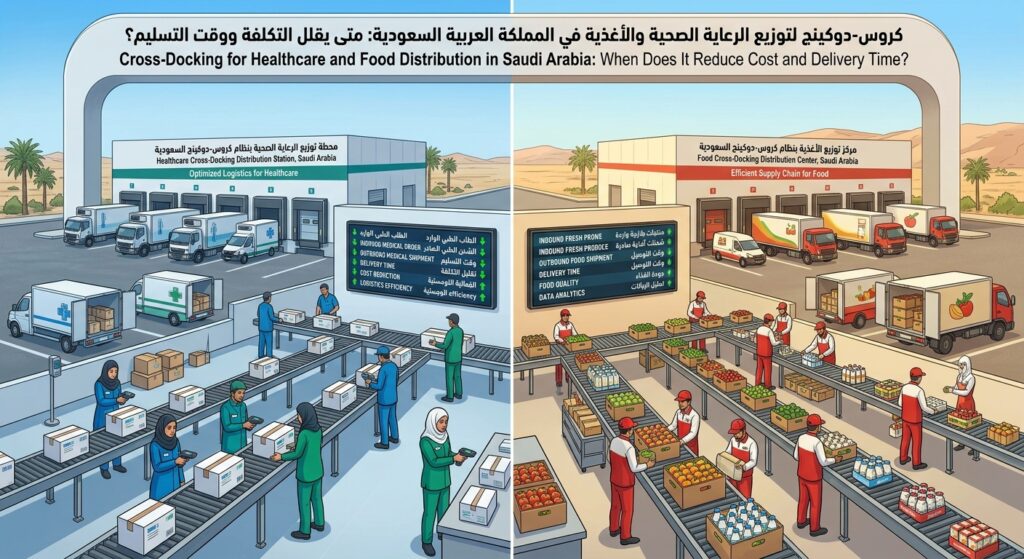
Among the most impactful supply chain strategies emerging in the Kingdom is cross-docking in Saudi Arabia. Cross-docking is a logistics practice where incoming freight from a manufacturer or supplier is unloaded at a central facility and immediately sorted, consolidated, and reloaded directly onto outbound vehicles with minimal to zero long-term storage.
While cross-docking offers significant efficiency gains across retail and e-commerce, its application in healthcare logistics and fresh food distribution carries unique operational nuances, regulatory demands, and financial trade-offs. This article explores how cross-docking works in Saudi Arabia, when it effectively drives down operational costs and delivery times, and the specific hurdles supply chain leaders must navigate.
The Operational Mechanics: How Cross-Docking Works
Traditional warehousing relies on storing goods in inventory racks until a customer places an order, which requires extensive floor space, picking personnel, and capital tied up in safety stock. In contrast, cross-docking operates on a “flow-through” paradigm:
- Inbound Transportation: Shipments arrive via refrigerated or dry transport from local factories, sea ports (such as King Abdulaziz Port in Dammam or Jeddah Islamic Port), or land borders.
- Screening & Quality Assurance: Goods undergo immediate physical inspection, barcode scanning, and temp-log verification (vital for pharmaceuticals and cold-chain foods).
- Sorting & Staging: Products are matched against real-time order requests from hospitals, clinic networks, hypermarkets, or restaurants.
- Outbound Dispatch: Consolidated multi-supplier shipments are loaded into final-mile delivery vans or regional distribution trucks, departing within a matter of hours.
Cross-Docking in Healthcare Logistics
Healthcare supply chains in Saudi Arabia are subject to rigorous oversight by the Saudi Food and Drug Authority (SFDA). The delivery of temperature-sensitive biologics, vaccines, life-saving pharmaceuticals, and surgical consumables requires uncompromising precision.
When Healthcare Cross-Docking Reduces Costs and Delivery Time:
- Elimination of Prolonged Storage Fees: Specialized cold-chain storage facilities compliant with GSDP (Good Storage and Distribution Practice) standards are expensive to build and operate. Reducing inventory residence time directly lowers energy consumption and warehouse overhead.
- Rapid Response for Critical Supplies: Direct transfer enables health clusters (T تجمع صحي) across remote provinces (e.g., Asir, Al-Jouf, Tabuk) to receive critical medical supplies within tight therapeutic windows.
- Reduced Expiration & Waste: Short-shelf-life goods, such as radioactive diagnostic agents or blood products, maintain maximum potency and minimal spoilage when moved directly from primary supplier to healthcare facility.
Challenges & Regulatory Constraints:
- Cold-Chain Continuity: Unloading and reloading temperature-sensitive pharmaceuticals (2°C–8°C or deep frozen) requires temperature-controlled cross-dock bays (dock seals and air curtains) to prevent thermal breaches.
- Track-and-Trace Compliance: SFDA’s Rased track-and-trace system mandates real-time tracking of every pharmaceutical unit code. Cross-dock operations must instantly sync scan data with the central database without stalling transit speed.
Cross-Docking in Food Distribution
Saudi Arabia’s food sector handles immense volumes of fresh produce, dairy, poultry, frozen goods, and dry staples. With high ambient summer temperatures exceeding 45°C, food logistics requires strict cold-chain integrity.
When Food Cross-Docking Reduces Costs and Delivery Time:
- Maximizing Produce Freshness: Farm-to-shelf duration is drastically compressed. Local produce from regions like Al-Qassim or Jizan can reach hypermarket shelves in Riyadh or Jeddah within hours, maximizing shelf-life and customer satisfaction.
- Consolidation of Last-Mile Delivery: Instead of multiple suppliers dispatching half-empty trucks to the same supermarket branch, cross-docking hubs consolidate multiple vendors’ goods into single, fully loaded delivery routes, cutting fuel burn and urban congestion.
- Lower Shrinkage & Spoilage Rates: Perishable items degrade exponentially with every additional day of handling. Minimizing touchpoints reduces product damage and spoilage losses.
Key Decision Matrix: When to Implement Cross-Docking
Cross-docking is not a universal solution. Supply chain directors must evaluate the following criteria to determine if cross-docking will generate positive ROI:
| Operational Parameter | High Cross-Dock Suitability | Low Cross-Dock Suitability |
| Demand Predictability | High, steady, and pre-allocated demand (e.g., daily hospital consumables, milk) | Volatile, seasonal, or unpredictable demand patterns |
| Product Perishability | High (vaccines, fresh meats, dairy) | Low (durable medical devices, canned goods) |
| Supplier Reliability | High (suppliers deliver on-time, pre-labeled, and pre-sorted) | Unreliable lead times, frequent order errors |
| IT Integration | Advanced WMS, EDI, and automated scanning | Manual, paper-based tracking methods |
Conclusion & Vision for Saudi Arabia’s Logistics Future
As Saudi Arabia moves toward its vision of becoming a primary global logistics crossroads, cross-docking will play a pivotal role in modernizing healthcare and food supply chains. By reducing reliance on long-term warehousing, lowering holding costs, and accelerating lead times, cross-docking enables healthcare networks to improve patient care and allows food distributors to deliver fresher produce with higher efficiency.
To succeed, companies operating within the Kingdom must invest in automated Warehouse Management Systems (WMS), train staff on SFDA compliance protocols, and establish temperature-controlled infrastructure that safeguards product integrity at every touchpoint.