Introduction
Veterinary medicines and feed additives play an important role in animal health, livestock production, and agricultural supply chains. From vaccines and veterinary pharmaceuticals to nutritional supplements and feed additives, these products require appropriate handling throughout storage and distribution.
In Saudi Arabia, the livestock and agricultural sectors depend on reliable logistics operations to ensure that veterinary products reach farms, veterinary clinics, distributors, and other customers in suitable condition.
However, these products present distinct storage challenges. Some require temperature-controlled environments, while others are sensitive to humidity, contamination, or improper handling.
Effective logistics management helps preserve product quality, maintain inventory accuracy, reduce waste, and support compliance with applicable regulatory requirements.
This article explores the essential considerations for storing and distributing veterinary medicines and feed additives in Saudi Arabia.
1. Understanding Veterinary Medicines and Feed Additives
Veterinary medicines include products used to prevent, diagnose, or treat diseases in animals. Examples may include vaccines, antibiotics, antiparasitic medicines, and other veterinary pharmaceutical preparations.
Feed additives, meanwhile, are substances incorporated into animal feed for specific nutritional, technological, or other authorized purposes.
These products may differ significantly in formulation, packaging, stability, and storage requirements.
Some veterinary medicines require refrigerated storage, while certain feed additives are supplied as powders, granules, or liquids that need protection from moisture and contamination.
Because their characteristics vary, warehouse operators should not apply identical handling procedures to every product.
Instead, storage and distribution practices should follow product-specific instructions and relevant regulatory requirements.
2. Why Proper Storage Conditions Matter
Inappropriate storage conditions can affect the stability, safety, and quality of veterinary products.
Excessive heat may degrade temperature-sensitive medicines, while moisture can cause certain powdered additives to clump or deteriorate.
Poor handling can also damage packaging and increase the possibility of contamination.
In Saudi Arabia, high outdoor temperatures make environmental protection particularly important during summer.
Warehouse operators should assess the risks associated with each product category and provide suitable storage conditions.
This may include controlled temperatures, appropriate ventilation, humidity management, and protection from direct sunlight.
Maintaining the correct environment helps preserve product integrity throughout its intended shelf life.
3. Temperature Management for Veterinary Medicines
Temperature management is essential for veterinary products with defined storage limits.
Certain vaccines and biological products require refrigerated conditions, while other medicines may be stored at controlled room temperatures according to their approved labeling.
Warehouse teams should follow manufacturer instructions rather than assuming that all veterinary medicines have the same temperature requirements.
Temperature-monitoring equipment can help detect deviations from established limits.
For products requiring controlled storage, documented monitoring, suitable equipment maintenance, and appropriate contingency procedures are important.
If a temperature excursion occurs, affected products should be assessed according to established quality procedures before they are released for distribution.
Reliable temperature management reduces the risk of product deterioration and supports supply chain quality.
4. Managing Humidity and Contamination Risks
Feed additives and certain veterinary formulations may be sensitive to moisture.
Excessive humidity can affect powder flow, packaging integrity, and product stability.
Warehouses should maintain clean storage areas and protect products from water leaks, condensation, and unsuitable environmental conditions.
Where required, humidity monitoring and suitable ventilation can support product protection.
Effective housekeeping and pest-control programs are also important, especially in facilities handling products associated with animal feed.
Products should be stored off the floor and arranged to permit cleaning, inspection, and safe handling.
Preventing contamination protects product quality and reduces the likelihood of unnecessary losses.
5. Segregation and Warehouse Organization
Proper segregation is a fundamental part of safe veterinary logistics.
Different product categories may have incompatible storage requirements or present contamination risks if handled together.
For example, veterinary medicines, feed additives, cleaning chemicals, and rejected inventory should be stored according to their respective requirements.
Products awaiting inspection or quality approval should be clearly distinguished from approved inventory.
Damaged, expired, or returned products may require dedicated quarantine locations.
Clear warehouse zoning, appropriate labeling, and controlled inventory status help prevent accidental mixing or distribution.
A well-organized warehouse supports product safety and improves operational efficiency.
6. Inventory Management and Expiration Control
Accurate inventory management is essential for veterinary medicines and feed additives.
Products with expiration dates should be monitored to prevent unsuitable stock from remaining in active inventory.
First Expired, First Out (FEFO) is often an appropriate inventory rotation method for products with defined expiration dates.
Warehouse teams should also record batch or lot numbers and other required identifiers.
A Warehouse Management System (WMS) can support inventory visibility, stock rotation, and traceability.
Regular stock reviews help identify slow-moving products, short-dated inventory, and replenishment needs.
Effective inventory management reduces waste and supports consistent product availability.
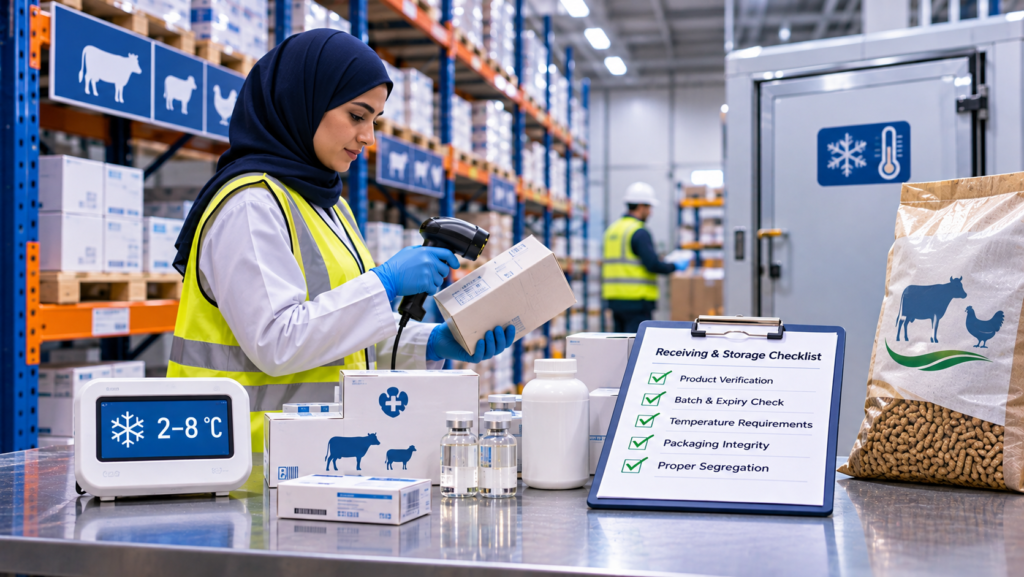
7. Safe Receiving and Quality Inspection
The receiving process is a critical control point for veterinary products.
When shipments arrive, warehouse personnel should verify delivery documents, quantities, product identification, and relevant batch information.
Packaging should be inspected for damage, leakage, broken seals, or signs of improper handling.
For temperature-sensitive products, receiving checks may include reviewing temperature records and confirming appropriate transportation conditions.
Any products with unresolved quality concerns should be segregated pending assessment.
Accurate receiving records help establish traceability from the moment products enter the warehouse.
Consistent inspection procedures also support supplier accountability and inventory accuracy.
8. Transportation and Distribution Challenges
Transporting veterinary medicines and feed additives across Saudi Arabia requires careful planning.
Long travel distances, high temperatures, and delivery schedules can create operational challenges.
Products must be transported under conditions appropriate to their characteristics and manufacturer instructions.
Temperature-sensitive medicines may require qualified temperature-controlled transportation arrangements.
Feed additives may need protection from moisture, contamination, and packaging damage.
Proper vehicle selection, secure loading, and suitable route planning help reduce transportation risks.
Coordinated deliveries also support timely availability for veterinary clinics, farms, and agricultural businesses.
9. Regulatory Considerations in Saudi Arabia
Veterinary medicines and animal feed products in Saudi Arabia are subject to applicable regulatory requirements.
The Saudi Food and Drug Authority (SFDA) has responsibilities relating to relevant veterinary medicines and animal feed products.
Businesses should verify the requirements applicable to each product category and activity, including importation, storage, distribution, labeling, and traceability where relevant.
Requirements may differ between veterinary pharmaceuticals, feed additives, and other animal health products.
Maintaining appropriate documentation and following established quality procedures supports regulatory compliance.
Companies should consult current official guidance rather than relying on general storage assumptions.
10. The Importance of Traceability
Traceability allows businesses to identify where products originated, how they moved through the supply chain, and where they were distributed.
For veterinary medicines, batch tracking can be particularly important when investigating quality concerns or managing product recalls.
Feed additives may also require accurate lot identification and distribution records.
Barcode systems and digital inventory platforms can improve traceability and reduce manual errors.
Businesses should maintain accurate receiving, storage, and dispatch records according to applicable requirements.
Strong traceability supports faster investigations and more effective inventory control.
11. Preparing for Seasonal Demand
Demand for veterinary medicines and feed additives may vary according to livestock production cycles, disease prevention programs, agricultural activities, and seasonal conditions.
Businesses should review historical demand patterns and coordinate with suppliers to anticipate changing inventory requirements.
Appropriate safety stock may help reduce shortages for essential products.
However, excess inventory can create additional storage costs and increase the risk of expiration.
Balanced forecasting and replenishment planning help businesses maintain product availability without unnecessary stock accumulation.
12. Choosing a Reliable Veterinary Logistics Partner
Businesses handling veterinary medicines and feed additives should carefully evaluate their logistics partners.
Important considerations include suitable storage environments, product segregation, inventory tracking, receiving procedures, and transportation coordination.
A logistics partner familiar with Saudi Arabia’s climate and distribution challenges can help businesses plan more effectively.
At Rabiyah Logistics, the importance of organized warehousing, accurate inventory management, and coordinated distribution reflects the broader need for dependable supply chain operations.
For veterinary and agricultural businesses, effective logistics planning helps support product protection, operational efficiency, and reliable deliveries.
Conclusion
Veterinary medicines and feed additives require careful storage, handling, inventory management, and distribution.
In Saudi Arabia, environmental conditions and transportation distances make appropriate logistics planning particularly important.
By following product-specific storage instructions, maintaining accurate traceability, preventing contamination, and coordinating transportation, businesses can reduce risks and protect product quality.
Reliable veterinary logistics ultimately supports animal health, agricultural productivity, and more resilient supply chains.