Introduction
Saudi Arabia’s cosmetics and personal care market includes skincare products, fragrances, makeup, haircare products, and beauty accessories. Maintaining the quality of these products throughout storage and distribution is an important responsibility for manufacturers, importers, retailers, and logistics providers.
The country’s hot climate creates additional challenges, particularly during summer when outdoor temperatures can be extremely high. Prolonged exposure to unsuitable temperatures may affect product consistency, appearance, fragrance, packaging, and shelf life.
Effective cosmetics warehousing therefore requires more than organized storage space. It involves environmental monitoring, careful handling, inventory rotation, and transportation planning.
By adopting appropriate warehouse practices, businesses can protect product quality, reduce preventable losses, and maintain customer confidence.
1. Why Cosmetics Require Appropriate Storage Conditions
Cosmetic products contain different combinations of ingredients, packaging materials, and formulations.
Some products are relatively stable under ordinary storage conditions, while others are sensitive to heat, humidity, sunlight, or temperature fluctuations.
For example, certain creams and lotions may experience changes in texture when exposed to excessive heat. Fragrances may undergo changes in their scent profiles, while some makeup formulations can soften or separate.
Packaging may also be affected by unsuitable environmental conditions.
Storage requirements should therefore be determined according to product characteristics and manufacturer instructions.
A suitable warehouse environment helps preserve the intended quality of products until they reach customers.
2. Understanding Heat-Related Risks in Saudi Arabia
High outdoor temperatures create significant challenges for cosmetics logistics in Saudi Arabia.
Products may be exposed to heat during unloading, temporary storage, warehouse transfers, or transportation.
Even short periods of exposure can become problematic for particularly sensitive formulations, depending on the temperature and product characteristics.
Potential risks include changes in texture, ingredient separation, discoloration, packaging deformation, and reduced product stability.
Businesses should identify products requiring additional protection and evaluate possible exposure points throughout the supply chain.
The objective is not to apply identical temperature requirements to every cosmetic product, but to maintain conditions suitable for each formulation.
3. Temperature-Controlled Cosmetics Warehousing
Temperature management is one of the most important considerations for cosmetics storage.
Warehouse operators should follow the storage conditions specified by manufacturers and applicable product requirements.
Depending on the product, this may involve climate-controlled storage areas, temperature monitoring equipment, or additional protection from environmental exposure.
Temperature sensors can help warehouse teams identify conditions that fall outside established limits.
Documented monitoring procedures also support investigation and corrective action when deviations occur.
Regular equipment maintenance is important for maintaining reliable environmental controls.
Businesses should avoid assuming that all cosmetics require refrigeration, as unsuitable low temperatures can also affect certain formulations.
4. Managing Humidity and Sunlight Exposure
Temperature is not the only environmental factor affecting cosmetics.
Excessive humidity can damage cardboard packaging, weaken labels, and create unfavorable storage conditions.
Direct sunlight may also affect certain formulations and packaging materials.
Warehouses should protect products from moisture accumulation, water leaks, and unnecessary light exposure.
Practical measures include maintaining suitable ventilation, inspecting storage areas, using appropriate shelving, and keeping products away from windows or direct sunlight when required.
Regular warehouse inspections can help identify environmental problems before they affect large quantities of inventory.
5. Safe Receiving and Product Inspection
The receiving process plays an important role in protecting cosmetics quality.
When shipments arrive, warehouse personnel should inspect packaging, verify quantities, and confirm relevant product information.
Checks may include product identification, batch numbers, expiration dates, packaging integrity, and visible signs of damage.
For temperature-sensitive cosmetics, receiving procedures may also require reviewing transportation conditions.
Products showing leakage, deformation, broken seals, or other quality concerns should be separated for assessment.
Accurate receiving records help businesses maintain inventory visibility and prevent potentially unsuitable products from entering distribution.
6. Inventory Rotation and Expiration Management
Cosmetics inventory management must account for product shelf life and changing consumer demand.
Some products carry expiration dates, while others may have specific durability or period-after-opening information.
Where appropriate, the First Expired, First Out (FEFO) method helps prioritize products with the earliest expiration dates.
This reduces the likelihood of products remaining in storage until they become unsuitable for sale.
Warehouse Management Systems (WMS) can support batch tracking, stock visibility, and inventory rotation.
Regular stock reviews also help identify slow-moving products and support timely replenishment decisions.
Effective inventory management reduces waste and protects business profitability.
7. Protecting Cosmetics During Handling and Packaging
Cosmetic products often use glass bottles, plastic containers, pumps, jars, and delicate retail packaging.
Improper stacking, handling, or transportation may cause breakage, leakage, or packaging damage.
Warehouse teams should use appropriate material-handling procedures and avoid excessive pressure on fragile products.
Additional protective packaging may be necessary for glass fragrances, premium skincare products, and other delicate items.
Order preparation should include verification of product quantities and packaging condition.
Proper handling helps maintain product presentation and reduces customer complaints, returns, and replacement costs.
8. Transportation Challenges for Cosmetics Distribution
Transportation is a critical stage of cosmetics logistics, particularly during Saudi Arabia’s hot summer months.
Products may experience elevated temperatures while vehicles are parked, shipments are loaded, or deliveries are delayed.
Businesses should evaluate transportation requirements according to product sensitivity and manufacturer instructions.
Appropriate vehicle selection, route planning, shipment scheduling, and temperature controls can help reduce environmental risks.
Loading and unloading procedures should minimize unnecessary exposure to extreme conditions.
For sensitive products, temperature monitoring during transportation may provide additional assurance.
Coordinated distribution planning helps maintain product quality from the warehouse to the final destination.
9. Regulatory Considerations for Cosmetics in Saudi Arabia
Cosmetic products in Saudi Arabia are subject to applicable requirements established by the Saudi Food and Drug Authority (SFDA).
Businesses involved in cosmetics importation, storage, and distribution should understand the regulatory obligations relevant to their activities.
These may concern product compliance, labeling, traceability, storage conditions, and handling of nonconforming products.
Regulatory requirements may vary according to product characteristics and business operations.
Warehouse operators should maintain accurate documentation and follow established procedures for identifying and managing damaged or unsuitable inventory.
Regularly reviewing current SFDA guidance helps businesses keep their operations aligned with applicable requirements.
10. Using Technology to Improve Cosmetics Warehousing
Digital systems can improve efficiency and accuracy in cosmetics supply chains.
A Warehouse Management System can help businesses track product locations, quantities, batches, and expiration dates where applicable.
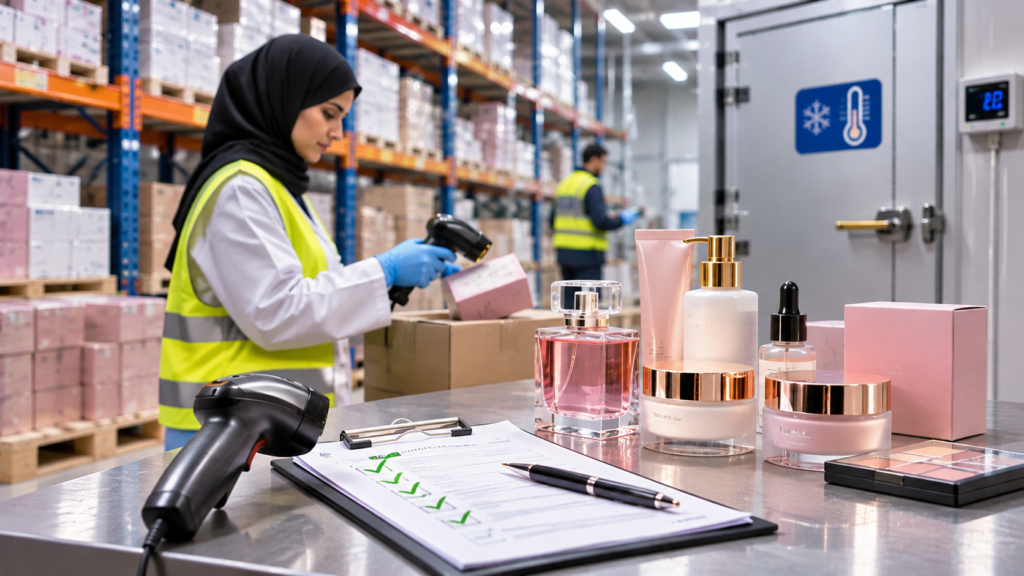
Barcode scanning reduces manual errors during receiving, picking, and dispatch.
Environmental monitoring systems provide information about storage conditions and can support timely responses to temperature deviations.
Inventory analytics can also help identify seasonal demand patterns and improve replenishment planning.
When supported by trained employees and documented procedures, these technologies strengthen warehouse operations and improve product visibility.
11. Choosing the Right Cosmetics Logistics Partner
Selecting a suitable logistics partner is important for cosmetics manufacturers, importers, distributors, and retailers.
Businesses should evaluate storage suitability, environmental controls, handling practices, inventory visibility, and transportation coordination.
A logistics partner familiar with Saudi Arabia’s climate and distribution conditions can help businesses plan for seasonal operational challenges.
At Rabiyah Logistics, the importance of dependable warehousing and organized distribution reflects the need to protect products throughout the supply chain.
For cosmetics businesses, reliable logistics planning supports product quality, operational efficiency, and customer satisfaction.
Conclusion
Cosmetics warehousing in Saudi Arabia requires careful attention to temperature, humidity, handling, inventory rotation, and transportation conditions.
The country’s hot climate makes proactive environmental management particularly important for sensitive beauty and personal care products.
By following manufacturer storage instructions, using appropriate warehouse systems, and coordinating distribution effectively, businesses can reduce product damage and avoid unnecessary losses.
Well-managed cosmetics logistics helps protect product quality, strengthen customer confidence, and support sustainable business growth.