Executive Summary
In healthcare logistics, product recalls are an inevitable reality. Whether triggered by manufacturing defects, cold-chain excursions, contamination, or regulatory mandates from authorities such as the Saudi Food and Drug Authority (SFDA), the speed and accuracy of a recall directly impact patient safety and organizational liability.
Implementing robust batch tracking and lot traceability within medical warehousing shifts recall readiness from a reactive scramble to a controlled, automated standard operating procedure. This guide outlines the core mechanics of batch control, key technology enablers, regulatory alignment, and actionable steps to accelerate recall response times.
1. Defining Batch Tracking vs. Lot Traceability
While often used interchangeably, batch tracking and lot traceability serve distinct structural roles in medical inventory systems:
-
Batch Tracking: Focuses on grouping products produced under identical conditions during a specific manufacturing run. A batch code ties a finished medical device or pharmaceutical lot to its raw materials, production line, shift, and quality control (QC) clearance.
-
Lot Traceability: Extends tracking downstream across the entire supply chain. It maps the movement of that specific batch through receiving, internal bin transfers, cross-docking, dispatch, and final delivery to hospitals, pharmacies, or patient end-users.
[Raw Materials / API] ➔ [Batch Production & QC] ➔ [Warehouse Inbound Scan] ➔ [Bin/Rack Assignment] ➔ [Outbound Serialization] ➔ [End-User Dispensing]
                                     └──────────────────── Traceability Arc ────────────────────┘
2. Regulatory Imperatives and Compliance Frameworks
Medical warehouses must adhere to stringent global and regional regulatory frameworks governing product traceability:
Global Standards (GS1 & Serialization)
-
GS1 DataMatrix Barcodes: Standardized 2D barcodes encoding Global Trade Item Number (GTIN), Expiry Date, Batch/Lot Number, and Unique Serial Number.
-
DSCSA & EU FMD: Mandates unit-level traceability to prevent counterfeit drugs and unauthorized distribution.
Regional Compliance: Saudi Food and Drug Authority (SFDA)
-
RSD Track-and-Trace System: In Saudi Arabia, the SFDA mandates end-to-end electronic reporting for human pharmaceuticals via the RSD platform. Every unit transaction—from import or manufacture to wholesale distribution and final point of sale—must be logged in real time.
-
Recall Classification Rules: SFDA classifies recalls into Class I (life-threatening/serious risk), Class II (remote probability of serious harm), and Class III (defects unlikely to cause harm). Class I recalls demand execution within hours, requiring instantaneous lot identification in warehouse management systems (WMS).
3. Core Capabilities of a Recall-Ready Medical Warehouse
To achieve rapid execution during a product recall, medical warehouses must implement five structural capabilities:
A. Granular Location Tracking & Bin Locking
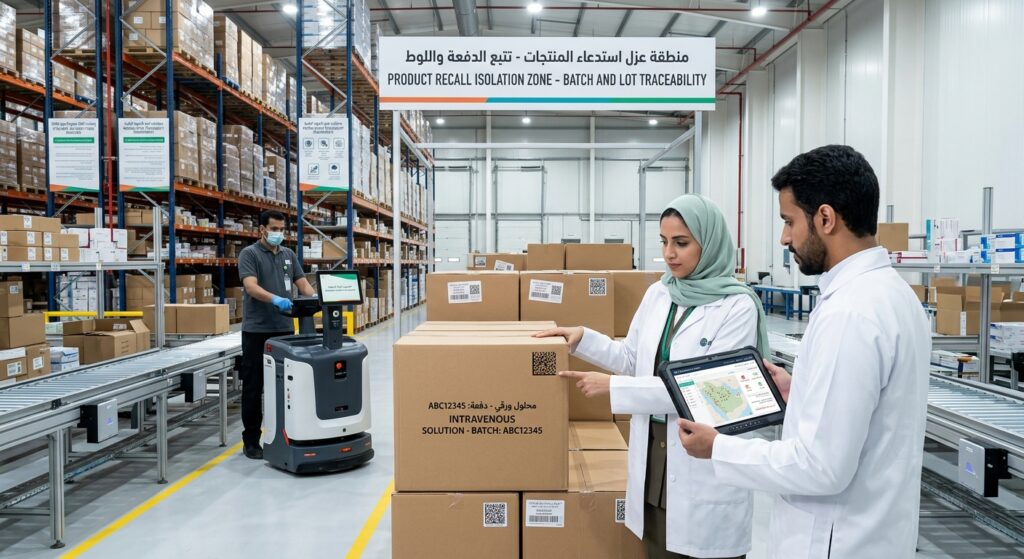
A modern WMS must maintain real-time visibility over exact pallet, case, and unit locations. When a recall alert is issued for a specific lot, the system must support instant quarantine logic:
-
Automated placement of “Hard Holds” on affected lot numbers.
-
Prevention of picking tasks generated for quarantined inventory.
-
Physical isolation in designated, temperature-monitored quarantine zones.
B. FEFO / FIFO Enforcement
Proper lot management mandates strict adherence to First Expired, First Out (FEFO) principles. Mixing lot numbers within the same pick location creates stock rotational errors and complicates recall isolation.
-
System-enforced single-lot storage locations.
-
Automated alerts for near-expiry inventory to prevent shipping non-compliant stock.
C. Automated Data Capture (RF & RFID)
Manual logging of batch and lot numbers on paper checklists introduces human error rates exceeding 3–5%, which is unacceptable during a critical recall.
-
Handheld Scanners (1D/2D): Validate GTIN, batch, and serial data at inbound dock doors, put-away, picking, and outbound loading.
-
RFID Systems: Allow bulk scanning of entire pallets or cases at cross-dock stations without line-of-sight requirements.
D. Upstream & Downstream Bilateral Mapping
Traceability must work in two directions:
-
Top-Down (Supplier to Patient): Given a defective manufacturing lot, identify every distribution center, hospital cluster, and customer that received units from that lot.
-
Bottom-Up (Patient to Supplier): Given an adverse patient event report, trace the exact batch, manufacturing site, storage conditions, and inbound shipment history.
4. Step-by-Step SOP for Accelerated Product Recalls
┌─────────────────────────┐      ┌─────────────────────────┐      ┌─────────────────────────┐
│ 1. Notification & Hold  │ ────>│ 2. System Quarantine    │ ────>│ 3. Physical Containment │
└─────────────────────────┘      └─────────────────────────┘      └─────────────────────────┘
                                                                               │
┌─────────────────────────┐      ┌─────────────────────────┐                   │
│ 5. Audit & Destruction  │ <────│ 4. Downstream Recall    │ <─────────────────┘
└─────────────────────────┘      └─────────────────────────┘
Phase 1: Immediate System Isolation (Minutes 0–15)
-
Receive official recall notification (Manufacturer or Regulatory Body like SFDA).
-
Input the target GTIN and Batch/Lot Number into the WMS/ERP.
-
Apply a global software lock to block all sales orders, cross-docking flows, and active picking queues containing the target batch.
Phase 2: Inventory Containment & Physical Separation (Minutes 15–60)
-
Generate a system-wide “Lot Inventory Location Report.”
-
Dispatch warehouse operators equipped with RF scanners to retrieve unpicked items from reserve and forward-pick locations.
-
Relocate all units to a secure, restricted-access Quarantine Storage Area (maintaining required temperature ranges, e.g., 2°C–8°C or 15°C–25°C).
Phase 3: Downstream Customer Notification (Hours 1–4)
-
Extract outbound shipping manifests and customer invoice logs associated with the recalled lot.
-
Generate an automated list of affected healthcare providers, pharmacies, or regional sub-depots.
-
Issue formal recall advisories containing product descriptions, lot numbers, serial ranges, and return instructions.
Phase 4: Reconciliation and Final Disposition (Days 1–7)
-
Account for 100% of the affected batch (Units in Stock + Units Returned + Units Consumed/Destroyed).
-
Submit preliminary and final recall reconciliation reports to the regulatory authority.
-
Coordinate authorized disposal or return-to-vendor (RTV) procedures in compliance with hazardous waste/pharmaceutical destruction standards.
5. Technology Stack Requirements for Modern Traceability
|
Component
|
Standard Requirement
|
Advanced / Best-in-Class Requirement
|
|
Warehouse Management System (WMS)
|
Batch-level inventory tracking with basic lot-lock functionality
|
Real-time serialization integration, API connectivity to regulatory portals (e.g., SFDA RSD), automated recall workflows
|
|
Data Capture Hardware
|
Handheld 2D Barcode Scanners
|
Fixed-mount industrial scanners on conveyor lines, RFID portals at dock doors
|
|
Temperature Monitoring
|
Manual logger downloads at receiving
|
IoT-enabled real-time continuous temperature tracking linked directly to batch records
|
|
Integration Protocols
|
CSV file transfers / Periodic batch sync
|
EDI (214, 856, 888), REST APIs for instant real-time data sync across ERP, WMS, and 3PL networks
|
Conclusion & Actionable Audit Checklist
Achieving rapid recall readiness requires continuous validation of your warehousing infrastructure. Use this checklist to audit your facility’s batch and lot traceability readiness:
-
[ ] Data Integrity: Are 100% of medical products scanned at inbound receiving with GTIN, expiry, and lot data recorded electronically?
-
[ ] System Locking: Can your WMS lock a specific batch number across all locations within less than 5 minutes?
-
[ ] Mock Recalls: Does your team conduct bi-annual “Mock Recalls” to verify if a lot can be fully traced upstream and downstream within a target window of 2 hours?
-
[ ] Physical Quarantine: Is there a dedicated, secure quarantine area capable of storing temperature-sensitive items under proper environmental conditions?
-
[ ] Regulatory Alignment: Are system interfaces updated to comply with current local track-and-trace requirements (such as SFDA RSD standards)?