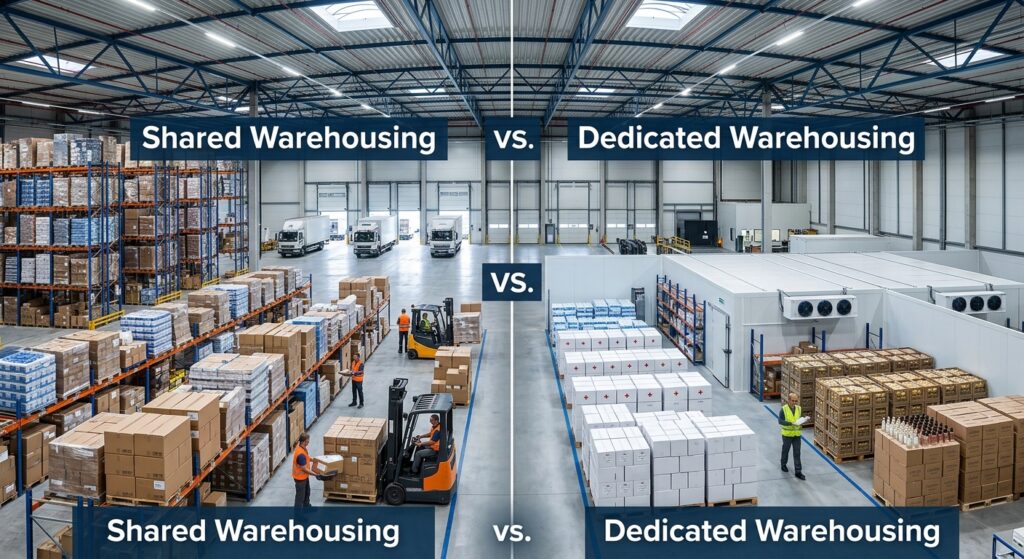
Choosing the right warehousing model is an important decision for suppliers operating in the medical, food, and cosmetics industries. Unlike general consumer goods, these products often have specific requirements for temperature, hygiene, security, traceability, shelf life, and regulatory compliance.
Two of the most common options are shared warehousing and dedicated warehousing. Shared warehouses allow multiple businesses to use the same facility and resources, while dedicated warehouses provide a facility or designated operation exclusively for one company.
The right choice depends on product characteristics, inventory volume, operational complexity, compliance requirements, and long-term growth plans.
What Is Shared Warehousing?
Shared warehousing, sometimes called multi-client warehousing or public warehousing, is a model where multiple companies store their products within the same logistics facility.
Each customer typically pays for the space and services they use rather than maintaining an entire warehouse independently.
This model can provide access to:
- Storage space
- Receiving and dispatch operations
- Inventory management
- Picking and packing
- Transportation coordination
- Temperature-controlled areas
- Warehouse management systems
- Specialized handling services
For smaller suppliers or businesses entering a new market, shared warehousing can be an attractive option because it reduces the investment required to establish a warehouse from scratch.
What Is Dedicated Warehousing?
Dedicated warehousing is a storage and fulfillment model designed exclusively for one company or operation.
The warehouse may be owned or operated by the supplier itself, or it may be managed by a third-party logistics provider on an exclusive basis.
Because the facility is dedicated to one customer, the company generally has greater control over:
- Warehouse layout
- Storage conditions
- Inventory processes
- Security
- Staffing
- Operating procedures
- Technology integration
- Quality-control processes
This additional control can be particularly valuable for companies handling sensitive products or large and predictable inventory volumes.
Shared vs. Dedicated Warehousing: The Key Differences
The biggest difference between the two models is flexibility versus control.
Shared warehousing generally offers greater flexibility because companies can scale their storage requirements according to demand. If inventory decreases, they do not necessarily have to continue paying for an entire facility.
Dedicated warehousing, on the other hand, provides greater operational control. Companies can design storage areas, processes, and workflows around their specific products and requirements.
A useful comparison includes five major factors: cost, scalability, control, compliance, and customization.
1. Cost
For many businesses, cost is the first consideration.
Shared warehousing can reduce fixed costs because warehouse infrastructure, equipment, labor, utilities, and technology are shared among multiple customers.
This can make it particularly attractive for small and medium-sized suppliers with relatively limited inventory.
Dedicated warehousing normally requires a higher financial commitment. However, when inventory volumes are consistently high, the greater control and operational efficiency can justify the additional cost.
The important question is not simply which model is cheaper, but which model provides the best total cost of operation for the business.
2. Scalability
Demand can change significantly in the food, cosmetics, and healthcare sectors.
Seasonal products may experience major increases in demand, while promotional campaigns, new product launches, or market expansion can suddenly increase inventory requirements.
Shared warehousing can provide an advantage in these situations because storage capacity can often be adjusted more easily.
Dedicated facilities may require companies to plan additional capacity well in advance. However, businesses with stable, high-volume operations can benefit from having warehouse capacity specifically designed around their forecasted demand.
Medical Products: When Control Becomes Critical
Medical and pharmaceutical products can require strict handling and storage procedures.
Depending on the product, suppliers may need controlled temperatures, restricted access, batch and lot tracking, expiration-date management, quarantine areas, and detailed documentation.
For these businesses, the question is not simply about available warehouse space. It is about whether the facility can consistently maintain the required product integrity and compliance controls.
A well-managed shared warehouse can still be suitable for medical products if the operator has the necessary infrastructure, procedures, trained personnel, monitoring systems, and regulatory controls.
However, companies handling highly sensitive products or complex inventory processes may benefit from dedicated facilities where they have greater control over operating procedures.
Food Suppliers: Temperature and Hygiene Matter
Food products introduce another set of warehousing challenges.
Depending on the product category, suppliers may require ambient, chilled, or frozen storage. Maintaining the appropriate temperature throughout receiving, storage, picking, and dispatch is essential.
Food warehouses also need effective hygiene, pest control, cleaning, stock rotation, and traceability procedures.
For products with short shelf lives, warehouse efficiency is particularly important. Systems such as FEFO (First Expired, First Out) can help ensure products approaching their expiration dates are dispatched before newer inventory.
Shared warehousing can work well for food suppliers when the operator has suitable temperature-controlled zones and established food-safety procedures.
Dedicated warehousing becomes more attractive when a supplier has specialized storage requirements, high inventory volumes, or processes that require a significant level of customization.
Cosmetics: Balancing Flexibility and Product Protection
Cosmetics may appear less demanding than medical or food products, but warehousing conditions can still affect product quality.
Some cosmetics can be sensitive to temperature, humidity, light, contamination, or prolonged storage.
In addition, suppliers often manage a large number of product variations, including different sizes, shades, formulations, and packaging formats.
Shared warehousing can help cosmetics companies manage changing product volumes without committing to a large facility.
For established brands with high SKU volumes and sophisticated fulfillment requirements, dedicated warehousing can provide greater control over inventory organization, product handling, and order fulfillment.
Compliance Should Influence the Decision
For medical, food, and cosmetics suppliers, compliance should be considered before choosing a warehouse—not afterward.
Businesses should evaluate whether a warehouse can meet the relevant requirements for:
- Temperature monitoring
- Product traceability
- Hygiene and sanitation
- Pest control
- Stock rotation
- Batch and lot management
- Expiration-date tracking
- Product segregation
- Security and access control
- Documentation and auditing
A warehouse may offer attractive pricing, but if it cannot reliably meet the product’s handling requirements, the apparent cost savings can quickly disappear through product losses, compliance issues, or customer complaints.
Technology Is Changing Both Models
Modern warehouse technology has also reduced some of the differences between shared and dedicated facilities.
A strong Warehouse Management System (WMS) can provide real-time inventory visibility, barcode scanning, batch tracking, expiration management, automated alerts, and detailed transaction histories.
Temperature sensors and monitoring systems can provide additional visibility for cold-chain products.
As a result, businesses should evaluate not only the physical warehouse but also the technology and processes supporting it.
Which Warehousing Model Should You Choose?
There is no universal answer.
Shared warehousing may be the better choice when:
- Inventory volumes are relatively low or variable.
- The business is entering a new market.
- Flexibility is more important than complete operational control.
- The company wants to minimize upfront warehouse investment.
- The warehouse provider already offers the required storage conditions and compliance capabilities.
Dedicated warehousing may be preferable when:
- Inventory volumes are consistently high.
- Products require highly specialized handling.
- The company needs customized workflows.
- Security and operational control are major priorities.
- The business has complex inventory or fulfillment requirements.
- Long-term demand makes a dedicated facility economically viable.
For many growing businesses, the decision does not have to be permanent. A company may begin with shared warehousing and transition to a dedicated facility as its inventory volume and operational complexity increase.
Final Thoughts
For medical, food, and cosmetics suppliers, warehousing is more than simply storing products on shelves. It is a critical part of maintaining product quality, customer satisfaction, regulatory compliance, and supply-chain performance.
Shared warehousing offers flexibility, scalability, and potentially lower fixed costs, making it an effective solution for businesses with changing demand or limited inventory volumes.
Dedicated warehousing offers greater control, customization, and operational consistency, making it attractive for businesses with specialized requirements or significant and predictable volumes.
The best choice should therefore be based on the company’s products, demand patterns, compliance requirements, growth strategy, and total logistics costs.
Ultimately, the goal is not to choose between shared and dedicated warehousing based solely on price. The right warehouse is the one that provides the appropriate balance of cost, capacity, control, compliance, and flexibility for the business’s current needs—and its future growth.